As artificial intelligence models evolve, the conversation around their utility in software development has shifted. In previous years, developers asked whether an AI could successfully generate a working function or a standalone script. Today, that is a solved problem. The real question for any developer evaluating a new model is much more demanding: how well does it perform across real, complex software development workflows?
We are no longer just asking for code snippets. We expect models to navigate existing project architectures, parse deep context spread across multiple files, debug elusive runtime errors, and reliably execute multi-step tool workflows. This brings us to a model that has recently dominated developer discussions. When evaluating Qwen3.8-Max for coding, the focus is squarely on its ability to handle these long-horizon, complex engineering tasks.
To understand why this model has gained significant traction, I have spent substantial time evaluating it firsthand. Rather than relying entirely on synthetic benchmarks, I integrated Qwen3.8-Max into my daily development routine. My testing included building and refactoring real Next.js web applications, managing React state, writing strict TypeScript, running agentic workflows, and debugging real-world logic errors.
This article examines what Qwen3.8-Max is, breaks down its technical capabilities, and provides a clear, evidence-based assessment of its strengths and weaknesses for professional software development in 2026.
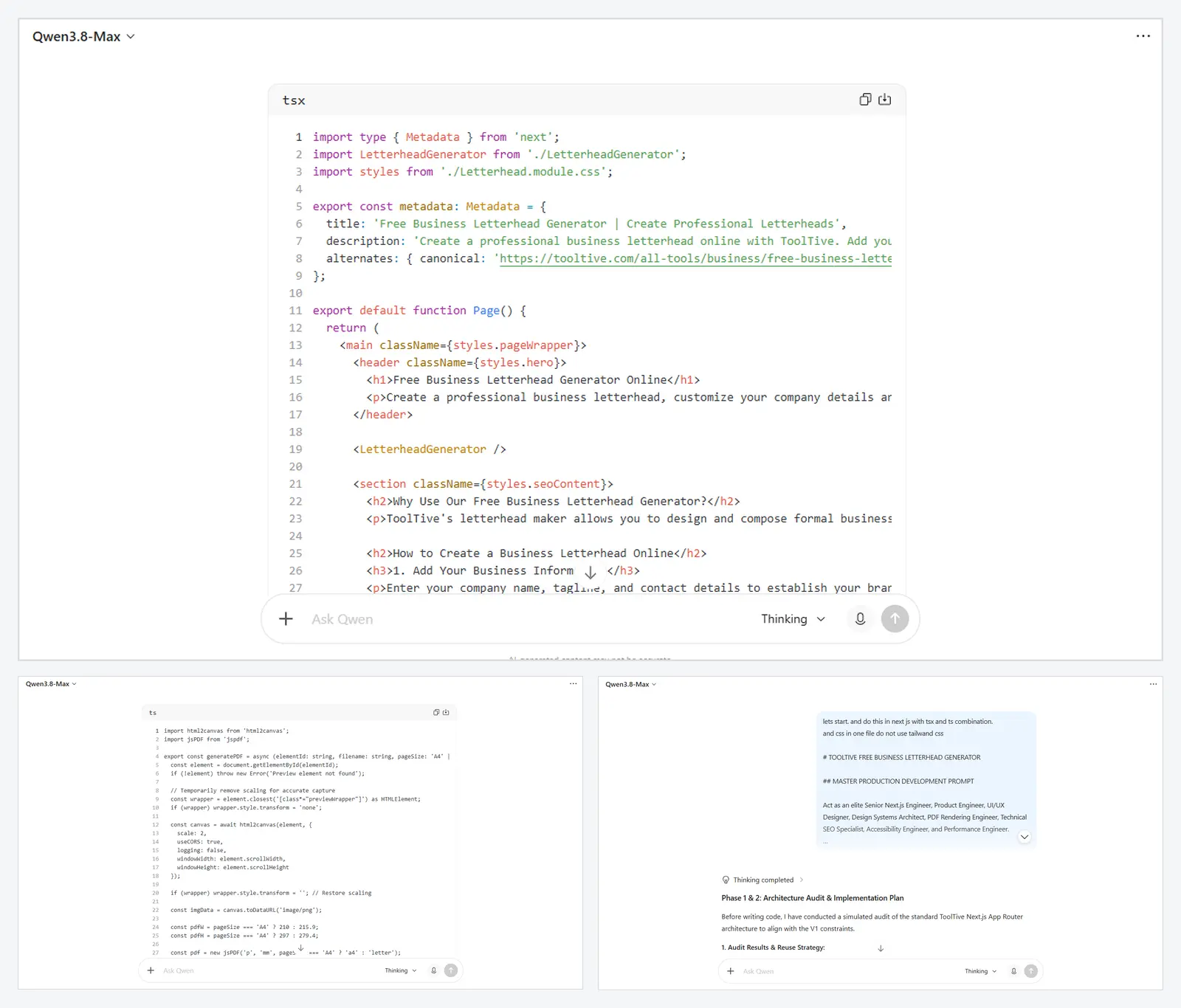
What Is Qwen3.8-Max?
Qwen3.8-Max is Alibaba’s latest high-end Qwen model, currently exposed through QwenCloud as qwen3.8-max-preview. It operates as a cloud-based, API-accessible intelligence designed specifically for complex reasoning and enterprise-scale software engineering.
According to official Alibaba specifications, it is a massive sparse Mixture-of-Experts (MoE) model. This MoE architecture allows it to maintain immense knowledge capacity while optimizing inference efficiency.
Crucially for developers, the model natively supports a 1-million-token context window. Alibaba has also implemented specialized parameters such as reasoning_effort and preserve_thinking, which give developers granular control over the depth of the model's logical processing during extended, multi-turn interactions. These architectural decisions signal a clear intent: qwen3.8-max-preview was built to act not just as a code completion engine, but as an autonomous coding agent capable of reasoning through entire repository structures.
Why Qwen3.8-Max Stands Out for Coding
The appeal of Qwen3.8-Max for developers goes beyond its sheer size. It stands out because its capabilities map directly onto the bottlenecks of modern software development. Here is an analysis of the practical features that make it highly effective.
Strong Context for Real Codebases
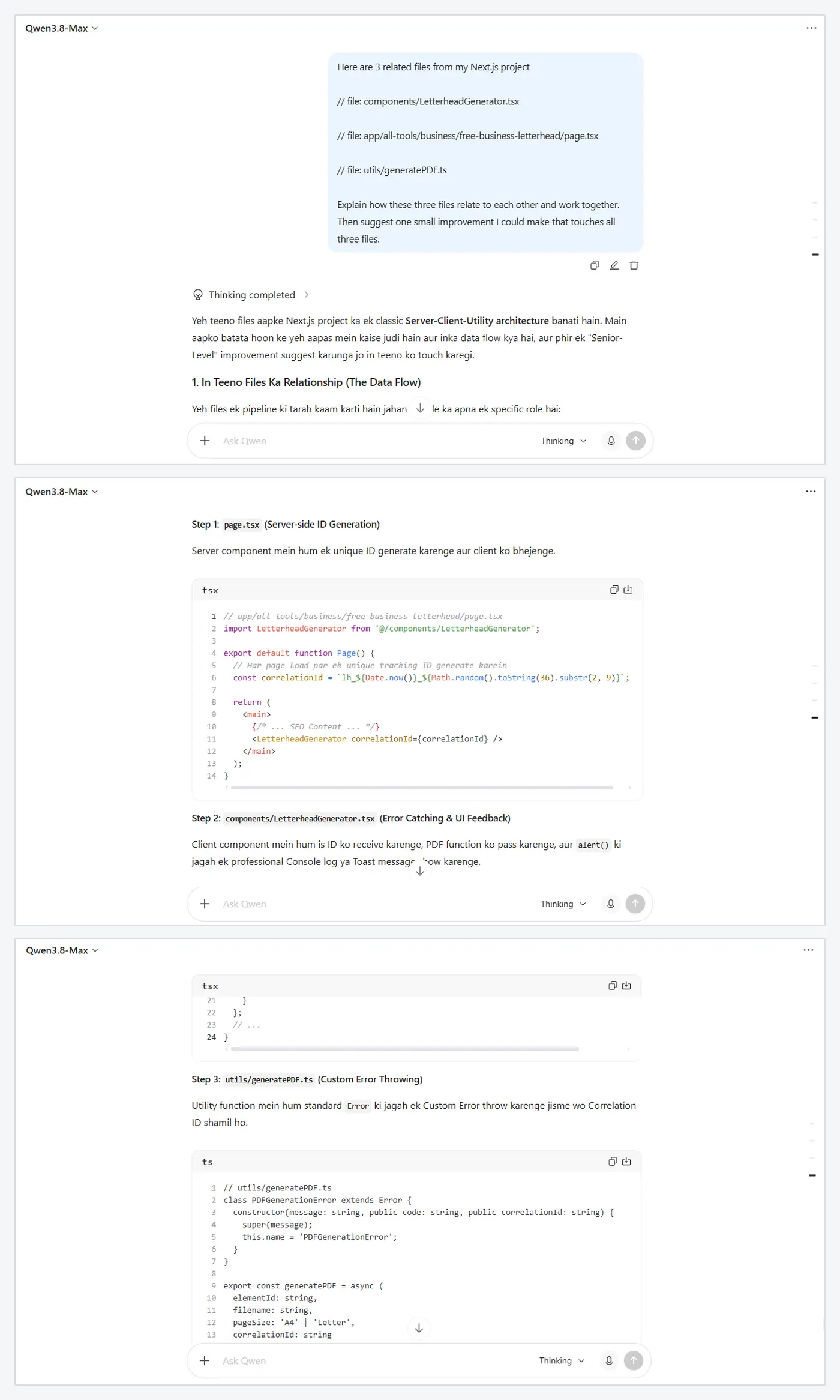
A persistent challenge with older AI models was "context amnesia." A developer would paste three interrelated files into a prompt, and the model would inevitably hallucinate a missing import or forget the defined schema of a central database model [PASTE INTERNAL LINK HERE].
According to official Qwen documentation, Qwen3.8-Max’s 1-million-token context window largely solves this mechanical limitation. However, merely holding tokens in memory is not enough; a coding model must reliably retrieve and correlate those tokens. External evaluations and my own testing indicate that Qwen3.8-Max is remarkably adept at absorbing entire directory structures—such as a Next.js app router setup along with its global CSS and configuration files—and maintaining a coherent understanding of how they interact. When you ask it to modify a deeply nested React component, it successfully remembers the prop interfaces defined hundreds of thousands of tokens earlier in the prompt.
Strong Reasoning for Multi-Step Development Tasks
Software development is inherently iterative. You rarely write a perfect feature in a single step. You analyze a requirement, plan a structural change, write the logic, encounter an error, diagnose the failure, and implement a fix.
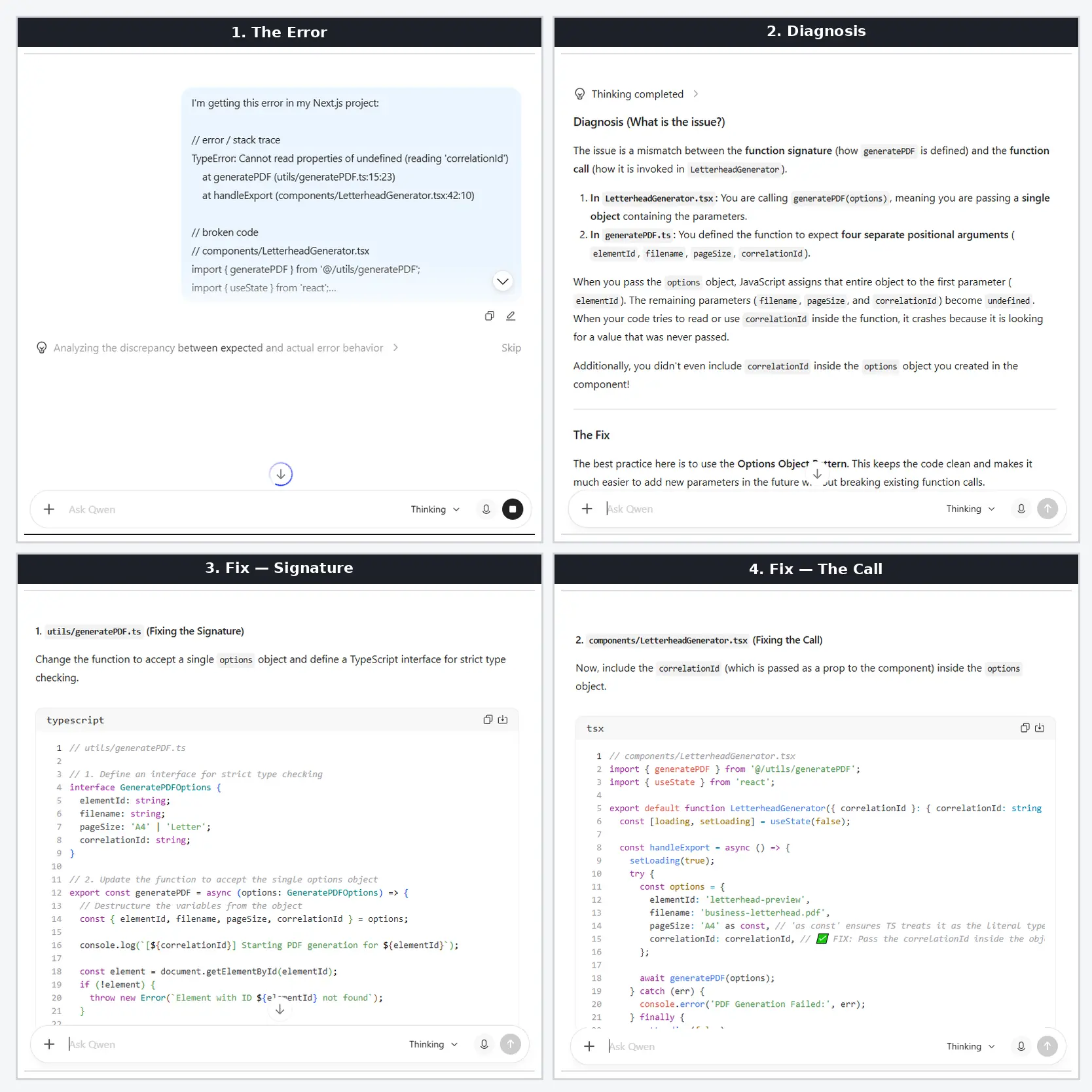
Qwen3.8-Max excels in this iterative loop because of its enhanced reasoning capabilities. Features like preserve_thinking allow the model to carry its logical deductions forward across multiple prompts. If you feed it a stack trace from a failed build, it does not just guess the syntax error. It works backward from the error output, cross-references the files in its context, identifies the logical misstep, and proposes a targeted correction.
Useful for Modern Web Development
The landscape of modern web development—particularly ecosystems involving Next.js, React, and TypeScript—moves rapidly. Models trained on outdated datasets often struggle with modern conventions, such as React Server Components or the latest Next.js caching strategies.
In practice, Qwen3.8-Max demonstrates an excellent grasp of modern, strict web development patterns. It understands the nuances of client versus server boundaries in Next.js. It reliably generates strictly typed TypeScript interfaces and avoids the common pitfall of reverting to lazy any types. When asked to implement complex state management, it correctly applies modern React hooks and external store paradigms without relying on deprecated lifecycle methods.
Debugging and Refactoring
Refactoring is a high-risk activity that requires a model to understand the intent of existing code before changing its structure. Independent reporting and practical use show that Qwen3.8-Max is highly effective at repository-level refactoring. It can take a monolithic, messy file and intelligently break it out into modular, reusable components while preserving the original business logic.
For debugging, the model's ability to ingest massive logs and cross-reference them against a wide codebase makes it a powerful diagnostic tool. However, it is vital to note that human oversight remains necessary. While it can identify structural issues and propose fixes, developers must still review the logic to ensure the AI has not misunderstood a subtle domain-specific requirement.
Agent and Tool Workflows
The most significant leap for Qwen3.8-Max is its optimization for autonomous, agentic workflows. Developers increasingly rely on agent harnesses (like Cursor, Cline, or custom LangChain setups) where the model uses tools to read files, run terminal commands, and edit code autonomously.
Independent benchmarks validate this strength. Qwen3.8-Max achieved a score of 86.6 on TerminalBench 2.1, 73.5 on FrontierSWE, and 67.7 on SWE-bench Pro. These scores position it competitively against leading models like Claude Opus and GPT-5.6 Sol in environments that require continuous tool calling, terminal interaction, and multi-step autonomous execution. It is highly capable of inspecting a repository, formulating an execution plan, and using file-editing tools to execute that plan iteratively.
What I Tested Qwen3.8-Max On
To ensure this assessment is grounded in reality, I used Qwen3.8-Max extensively as my primary assistant for building and maintaining modern web applications. The testing environment focused heavily on Next.js (App Router), React 19, strict TypeScript, and modular CSS. I deliberately avoided isolated algorithm tests, focusing instead on the messy, integrated reality of a production codebase.
Here is a summary of how Qwen3.8-Max performed across different real-world tasks during my first-hand testing:
| Task | Experience |
|---|---|
| Next.js | Strong. Readily navigates App Router patterns, server actions, and API routes. |
| React | Strong. Excellent at breaking down complex UIs into modular, reusable components. |
| TypeScript | Strong. Consistently generates strict, accurate types and handles complex generics well. |
| Debugging | Strong. Highly effective at tracing runtime errors across multiple interconnected files. |
| UI generation | Strong. Generates clean, accessible markup and understands modern CSS methodologies. |
| Refactoring | Strong. Successfully untangles monolithic files into logical, separated modules. |
| Large codebases | Useful with careful context. Requires precise prompting but reliably holds project architecture. |
| API integration | Strong. Accurately writes fetch logic, error handling, and data parsing schemas. |
| Agent/tool workflows | Promising. Follows multi-step tool execution well, although occasional course-correction is needed. |
In regular development use, the most noticeable advantage was the reduction in cognitive load. Instead of manually cross-referencing five files to understand why a prop was undefined, I could provide the files to Qwen3.8-Max, and it would consistently pinpoint the missing data fetch in a parent server component.
What Qwen3.8-Max Does Particularly Well
Through my testing, several specific strengths stood out that directly benefit a developer's daily workflow:
- Maintaining Multi-File Coherence: When implementing a feature that touches a database schema, an API route, a frontend state store, and a UI component, Qwen3.8-Max successfully orchestrates the changes across all files simultaneously without losing track of variable names or data shapes.
- Adhering to Strict Instructions: The model excels at following negative constraints. If you instruct it to "use vanilla CSS instead of Tailwind" or "do not modify the existing error handling logic," it respects those boundaries much more reliably than earlier generations of AI models.
- Explaining Unfamiliar Code: When navigating an undocumented, legacy section of a codebase, Qwen3.8-Max serves as an excellent technical translator. It accurately summarizes complex logic and identifies the purpose of obscure functions.
- Iterative Development: The model handles follow-up corrections gracefully. If a generated UI component looks incorrect, simply telling the model "the alignment is broken on mobile" usually results in a precise, targeted CSS fix rather than a chaotic rewrite of the entire file.
Where Qwen3.8-Max Still Has Limitations
Despite its impressive capabilities, Qwen3.8-Max is not a flawless, autonomous developer. Understanding its limitations is just as important as knowing its strengths. Based on first-hand observation and current verified evidence, here is where developers need to exercise caution:
Context Saturation Limits Reasoning While the model can technically ingest 1 million tokens, dumping an entire uncurated repository into the prompt is rarely the best strategy. In my experience, providing too much irrelevant code can dilute the model's focus. The reasoning quality is always highest when you provide a large but meticulously curated context window containing only the files relevant to the current task.
Agentic Drift When running in autonomous tool-calling loops, Qwen3.8-Max can occasionally experience "agentic drift." If it encounters an unexpected terminal error, it might attempt to fix it by taking increasingly complex and unnecessary steps, drifting away from the original goal. Developers must still monitor autonomous agents to interrupt and steer the model when it goes off track.
Latency with High Reasoning
According to independent reporting and practical use, when utilizing the highest settings for reasoning_effort, the model can exhibit slower response times. The trade-off for deep, multi-step logical planning is increased latency, which can mildly disrupt the flow of rapid, interactive coding sessions.
Occasional Incorrect Assumptions Like all large language models, it can sometimes confidently make incorrect assumptions about third-party library APIs, especially if those libraries have released breaking changes very recently. Human code review remains a mandatory step.
Is Qwen3.8-Max Good for Professional Software Development?
Yes, Qwen3.8-Max is an exceptionally powerful tool for professional software development, provided it is used correctly.
It does not replace a software engineer. It cannot independently architect a secure, scalable application from zero without human direction. However, it drastically accelerates the implementation phase. It is best viewed as a highly capable, tireless senior pair programmer.
For experienced developers, Qwen3.8-Max eliminates the friction of boilerplate, accelerates refactoring, and dramatically reduces time spent debugging cryptic error messages. For junior developers, it acts as an on-demand mentor that can explain complex patterns and enforce best practices like strict TypeScript typing. In a professional environment, developers who integrate Qwen3.8-Max into their workflows will find they spend less time typing syntax and more time focusing on architecture and business logic.
Who Should Use Qwen3.8-Max for Coding?
Given its profile, Qwen3.8-Max is particularly well-suited for:
- Next.js and React Developers: It possesses a deep, modern understanding of these frameworks.
- TypeScript Developers: It excels at generating and enforcing strict type safety.
- Engineers Working in Large Codebases: The massive context window makes it ideal for navigating complex, multi-file architectures.
- AI-Assisted Developers: Those using agentic tools (like Cursor) will benefit greatly from its high tool-calling benchmarks.
- Indie Hackers: Solo developers looking to drastically multiply their output and handle full-stack implementations quickly.
Final Verdict: Why Qwen3.8-Max Is So Good for Coding in 2026
Qwen3.8-Max stands out in 2026 not simply because it boasts massive parameter counts or wins isolated coding benchmarks, but because it performs remarkably well across the messy, interconnected workflows that developers actually experience.
By combining a 1-million-token context window with sophisticated reasoning controls and top-tier agentic tool-calling capabilities, Alibaba has delivered a model that truly understands software architecture. In my own daily use building Next.js applications, its ability to retain deep context, accurately debug multi-file errors, and output clean, strict code makes it an undeniable asset. While human review remains essential, Qwen3.8-Max currently represents one of the most capable and reliable AI partners available for modern software development.
Frequently Asked Questions
Is Qwen3.8-Max good for coding?
Yes. Qwen3.8-Max is designed for demanding software engineering tasks, with a large context window, extended thinking, and strong tool-calling capabilities that make it useful for coding, refactoring, and debugging.
Is Qwen3.8-Max good for Next.js and React?
Yes. In practical testing, Qwen3.8-Max demonstrates a strong understanding of modern web development paradigms, including Next.js App Router conventions, React server/client boundaries, and modular component design.
Can Qwen3.8-Max handle large codebases?
It supports a 1-million-token context window, which can be useful for working with large amounts of related code and documentation. In practice, focused and relevant context still produces more reliable results than sending an entire repository without structure.
Is Qwen3.8-Max better than Claude for coding?
There is no universal winner. Qwen3.8-Max is a strong option for long-context and tool-driven coding workflows, while Claude may be preferable for some developers depending on the task and workflow.
Is Qwen3.8-Max better than ChatGPT for coding?
It can be a strong alternative depending on your workflow. Qwen3.8-Max offers a large context window, extended thinking, and tool-calling capabilities that can be useful for long-horizon coding tasks. Whether it is better than ChatGPT depends on the specific model, task, and development workflow being compared.
Can Qwen3.8-Max debug existing code?
Yes. It excels at tracing logical errors across multiple files. By ingesting stack traces alongside the relevant codebase context, it can reliably identify root causes and propose targeted fixes.
Can Qwen3.8-Max work with coding tools and agents?
Yes. Qwen3.8-Max was built with agentic workflows in mind. It achieves high scores on benchmarks evaluating autonomous tool execution, making it highly effective for environments that require file reading, writing, and terminal interaction.
Should developers use Qwen3.8-Max for professional projects?
Yes, developers should consider using it as an advanced productivity tool. While human oversight and code review remain mandatory, it significantly accelerates implementation, refactoring, and diagnostic workflows in professional environments.